 by
by 
Organizations everywhere are looking for experienced talent. Executive search firms search. Recruiters interview. Yet critical positions remain unfilled as employers compete for the same limited pool of people with the exact experience they believe they need.
That raises an important question: If everyone wants experienced employees, who is creating them?
Hiring will always be an important part of workforce strategy. But organizations cannot hire their way through every skills shortage, technological shift or changing business requirement. Talent sustainability requires something more: a deliberate system for building and maintaining the capabilities an organization needs over time.
The Capability Ecosystem
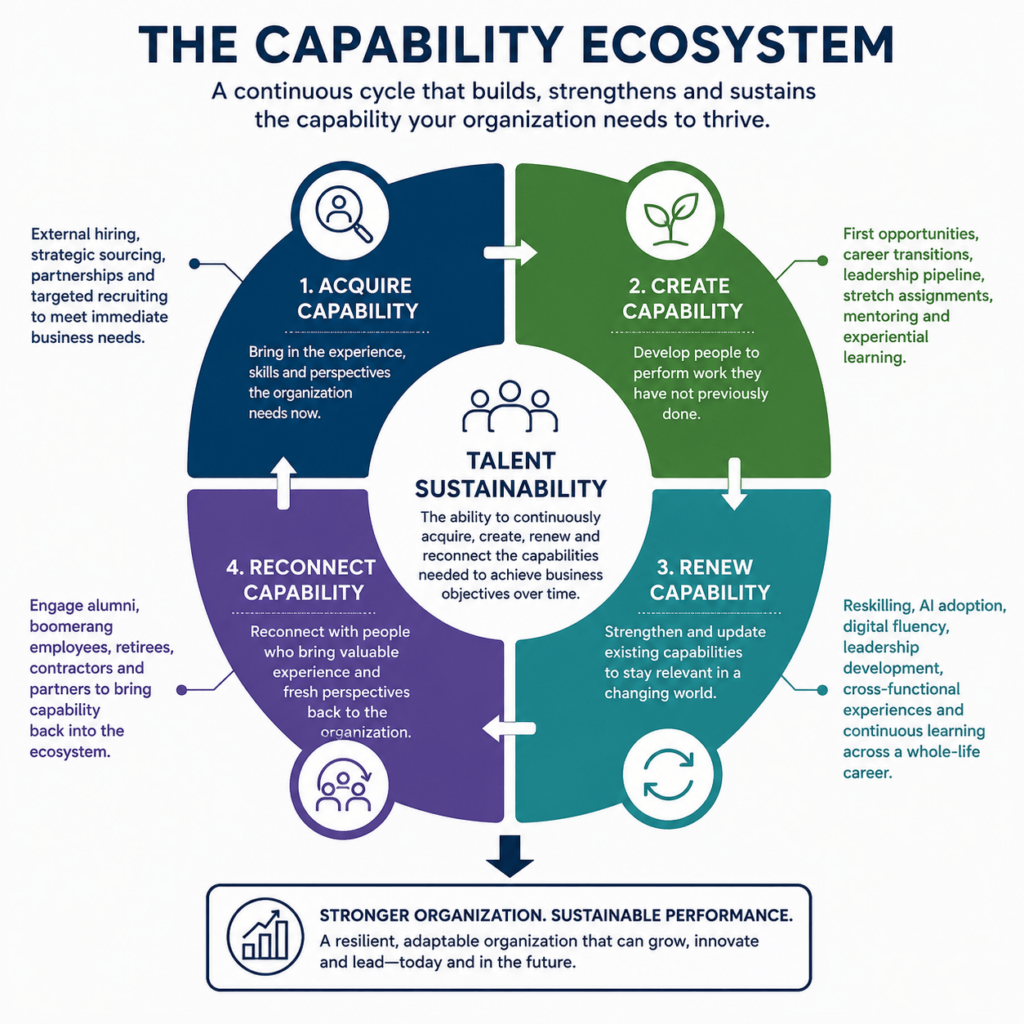
A Capability Ecosystem is the interconnected system through which an organization acquires, creates, renews and reconnects the capabilities needed to sustain business performance.
It consists of four mutually reinforcing elements:
Capability acquisition brings external talent into the organization when new or additional expertise is needed.
Capability creation deliberately develops people to perform work they have not previously done, building future capability before it becomes an urgent business need.
Capability renewal keeps existing expertise relevant as technologies, markets and customer expectations change. This includes reskilling, AI adoption, leadership development, cross-functional experience and continuous learning throughout a whole-life career.
Capability reconnection brings previously developed knowledge and skills back into the organization through former employees, project-based engagements, contingent talent and intentional return pathways.
Together, these practices shift the focus from continually searching for ready-made talent to continually strengthening organizational capability.
From Talent Acquisition to Talent Sustainability
Building a strong Capability Ecosystem requires several leadership shifts.
First, look beyond years of experience to consider learning agility: who has demonstrated the ability to learn, adapt and solve unfamiliar problems?
Second, create internal pathways. Identify people who could perform critical roles in the future and provide the stretch assignments, mentoring, cross-functional experience and development needed to prepare them.
Third, maintain relationships with former employees. People leave organizations for many reasons and may later return with valuable new knowledge and experience.
Fourth, reward managers for developing talent for the enterprise, not simply retaining people on their own teams.
Finally, make capability renewal everyone’s responsibility. As work changes, continuous learning cannot be treated as an occasional training initiative. It must become part of how work gets done.
Building Capability Before You Need It
Organizations can measure the health of their Capability Ecosystem through internal mobility, leadership readiness, return hires, AI adoption, cross-functional movement and time-to-productivity.
The objective isn’t to eliminate external hiring. It’s to create a healthier balance between buying capability and building it.
Organizations that continually acquire, create, renew and reconnect capability are better positioned to respond to demographic change, technological disruption and evolving customer expectations. More importantly, they create opportunity for people to continue learning, contributing and developing throughout a whole-life career.
That is the foundation of talent sustainability.
A previous version of this article was published on Forbes: https://www.forbes.com/sites/sheilacallaham/2026/07/31/everyone-wants-experienced-employees-but-whos-creating-them/

Leave a Reply