 by
by 
As artificial intelligence reshapes work, employers face a legitimate concern: Will everyone be able to keep up?
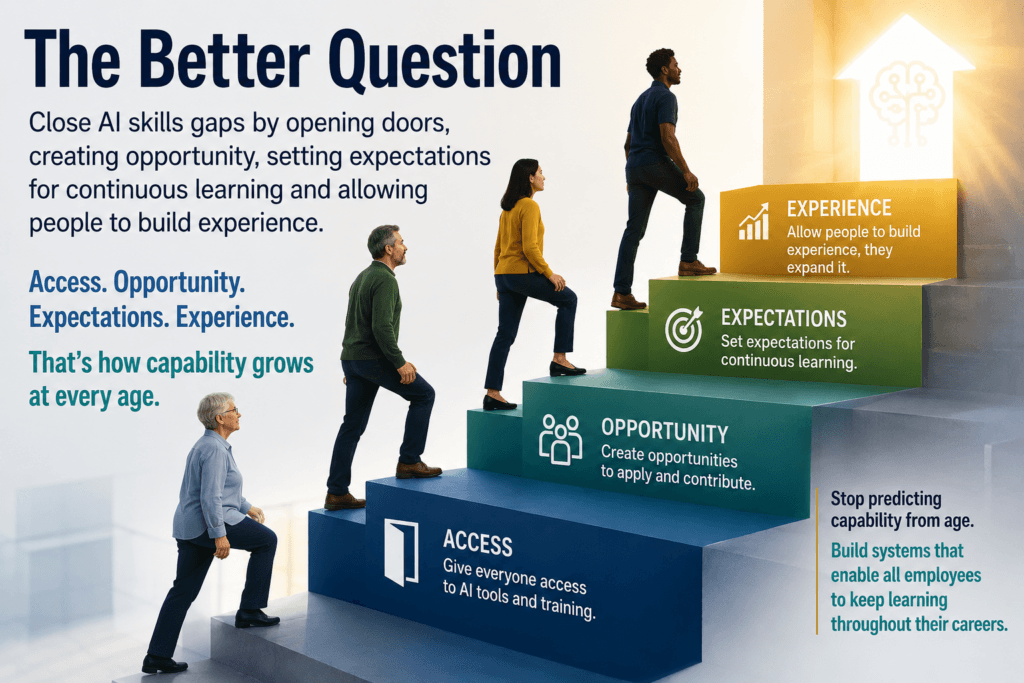
AI capability grows when employees have access to tools and training, opportunities to apply what they learn, expectations for continuous learning and experience gained through meaningful work. Source: Age Equity Alliance. Image created using OpenAI.
Workplace Intelligence’s Top 10 Workplace Trends for 2026 predicts that AI could widen existing skills gaps as adoption accelerates. The report points to differences in AI confidence and use across the workforce and warns that some employees could be left behind.
It’s an important warning. But there is added risk in how organizations interpret it.
When differences in AI adoption are attributed to age, employers may mistake an organizational problem for an individual one.
Age doesn’t determine someone’s ability or willingness to learn AI. Access, opportunity, expectations and experience are much better predictors of who develops new capabilities. And employers influence all four.
When Assumptions Become Outcomes
Consider two employees with limited experience using generative AI.
One receives access to approved tools and training. Their manager encourages experimentation and invites them to participate in an AI pilot. Through repeated use, they gain experience and confidence.
The other employee isn’t offered the same opportunities because their manager assumes they won’t be interested or capable.
Six months later, one employee is demonstrably more proficient.
Is that evidence of an age-related skills gap? Or an opportunity gap?
Organizations should take care not to create the disparities they later use as evidence that their assumptions were correct.
This is how the four factors reinforce one another. Access determines who gets the tools and training. Opportunity determines who gets to apply what they learn. Expectations influence who managers encourage and invest in. Experience accumulates as a result.
AI Has Raised the Stakes
Age-related stereotypes about technological ability aren’t new. What’s different is the speed at which AI is changing work. In today’s tech environment, workers of all ages are pressed to keep up.
In 2024, research I reported on in Forbes found that hiring managers showed a strong preference for younger candidates when considering jobs requiring significant AI use. Yet those same employers reported strong performance from employees age 45 and older who were already using AI.
That contradiction matters.
It demonstrates how quickly assumptions about who is likely to possess a skill can become disconnected from evidence about who can actually use it.
As AI becomes embedded in more jobs, access to AI development can influence productivity, mobility and future employability. Employees who build AI capability may become candidates for new assignments and roles. Those who don’t have that opportunity risk being excluded from them.
That makes equitable access to AI development a talent sustainability issue.
Look at the System, Not the Birth Date
Organizations concerned about AI readiness should resist predicting who will adapt based on demographic characteristics. Instead, leaders should examine the conditions under which people are being asked to adapt.
Who has access to approved AI tools and formal training? Who is encouraged to experiment? Who gets invited to pilots and receives assignments requiring AI? Whose manager actively supports skill development? And who is quietly assumed not to be interested?
Those questions reveal much more about organizational AI readiness than age ever will.
Build Capability Across a Whole-Life Career
The traditional career model often concentrated learning and development earlier in working life, followed by an expectation that accumulated experience would carry employees through the rest of their careers.
That model no longer fits.
Technology changes too quickly. Careers are longer and increasingly nonlinear. People change roles, industries and employment arrangements. They leave and re-enter the workforce. Skills that are valuable today will inevitably need to evolve.
Learning can’t belong to one career stage. It must be continuous.
AEA describes this as the whole-life career: a model in which people continue developing, adapting and contributing throughout their working lives, with opportunities to acquire new capabilities, move between roles and step away from and return to work when life requires it.
AI makes this model even more important. Organizations can’t sustainably recruit their way around every technological shift. They must also become good at developing the people they already have.
From Age Mindset to Longevity Mindset
An ageist mindset attaches expectations to people based on how old they are. It assumes age tells us something meaningful about adaptability, ambition, technological capability or willingness to learn.
The Longevity Mindset Advantage recognizes instead that longer lives and more fluid careers expand the opportunity for people and organizations to continually develop and benefit from human capability.
If leaders assume they know who will embrace AI, they narrow their talent pool before anyone has demonstrated what they can do.
If they provide access, create opportunities, set expectations for continuous learning and allow people to build experience, they expand it.
The Better Question
There will almost certainly be AI skills gaps in organizations. There will almost certainly be AI skills gaps in organizations. What may surprise some leaders is that they will impact workers across every age group.
The better questions to ask are what creates these gaps and what are the paths to closing them?
In other words, before concluding that some employees are falling behind, leaders should determine whether everyone has been given a reasonable opportunity to move forward.
Audit access to AI tools and training. Examine who participates in pilots and receives AI-enabled assignments. Look for patterns in development opportunities and outcomes across age groups. Hold managers accountable for ensuring their respective teams have access to the training they need.
Most importantly, stop predicting capability from age.
The organizations best positioned for an AI-enabled future won’t be those that identify the age group supposedly most comfortable with the latest technology.
They’ll be the ones building systems that enable all employees to keep learning throughout their careers.
Leave a Reply