 by
by 
Because workforce strategies that overlook age-neutral design risk excluding capable talent at scale.

In 2026, workforce strategy can no longer be separated from how organizations design systems that attract, develop, and retain employees of all ages. The forces shaping today’s workplace are converging—demographic ageing, accelerated AI adoption and a labor market under sustained pressure. Together, they are reshaping how talent is sourced, developed, and retained, while exposing gaps in systems that were not designed for longer, flexiblecareers.
Demographic Ageing
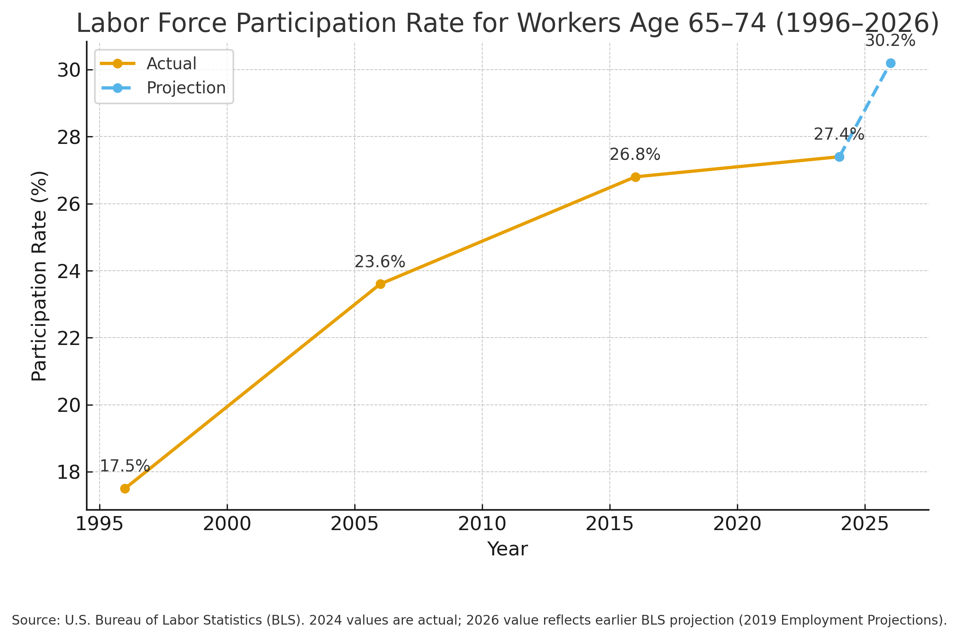
Across the globe, increased longevity combined with decades of declining birth rates has resulted in a workforce that includes more people working into their 50s, 60s, and 70s than at any point in history. In the United States, labor force participation among people aged 65–74 reached its highest level on record in 2024, underscoring a long-term shift employers can no longer treat as temporary or exceptional.
AI Disruption
At the same time, automation and AI are reshaping how careers begin, pause and progress. While much attention has focused on productivity gains, less scrutiny has been given to how hiring, screening and evaluation systems quietly shape access to opportunity. These systems increasingly determine who is seen, who advances and who is filtered out—often long before human judgment enters the process.
The result is a growing mismatch between workforce realities and the systems meant to support them. Many employers continue to rely on assumptions about career stage, potential or fit that narrow talent pipelines at both ends of the age spectrum. When job design, hiring criteria or advancement pathways rely on age-coded signals rather than skills, outcomes or performance expectations, capable people opt out—or are screened out—at scale.
This is not simply an inclusion issue. It is a talent sustainability risk.
Systems Can Create Risk
As economic pressure increases and organizations move faster, design flaws become more visible. Systems built for speed and efficiency can unintentionally reinforce bias, disrupt continuity and weaken performance—exactly when stability and adaptability matter most. Age bias rarely acts alone; it compounds with other structural inequities, increasing the likelihood of stalled mobility and long-term disengagement.
An example of this can be seen in the ongoing collective age discrimination in AI-hiring lawsuit against Workday. The case, Mobley versus Workday, Inc., may become one of the largest age discrimination lawsuits in U.S. history. The opt-in period is now open and applies to workers age 40 and above who applied for a job through the Workday portal since September 2020. Workday serves more than 65% of the Fortune 500, including over 70% of the top 50 companies, with customers operating in 175 countries. That scale is central to the case.
A Design Challenge
At Age Equity Alliance, we see this moment as a talent design challenge, not a demographic one. The longevity mindset advantage and whole-life career lens recognize that people will move in and out of roles, responsibilities, and learning phases over longer working lives. Workforce strategies that support employees of all ages are more resilient, more inclusive, and better aligned with today’s workplace reality.
2026 is the year age bias becomes a business liability—not because it is new, but because employers can no longer afford to overlook it. Organizations that treat age-neutral design as central to workforce strategy will be far better positioned to retain talent, sustain performance and navigate whatever comes next.
Age Equity Alliance works with employers to identify where workforce systems unintentionally exclude capable talent and to redesign those systems for longer, more dynamic careers. Contact us for more information.
Related analysis by the author appears regularly in Forbes.
This article draws in part on analysis previously published by the author in Forbes (November 2025):
“In 2026, Age Bias Will Become Impossible For Employers To Ignore.”

Leave a Reply